Top 10 Highest Towers in the World
Top 10 Highest Towers in the World — Ultimate Guide to the Tallest Structures (2026)
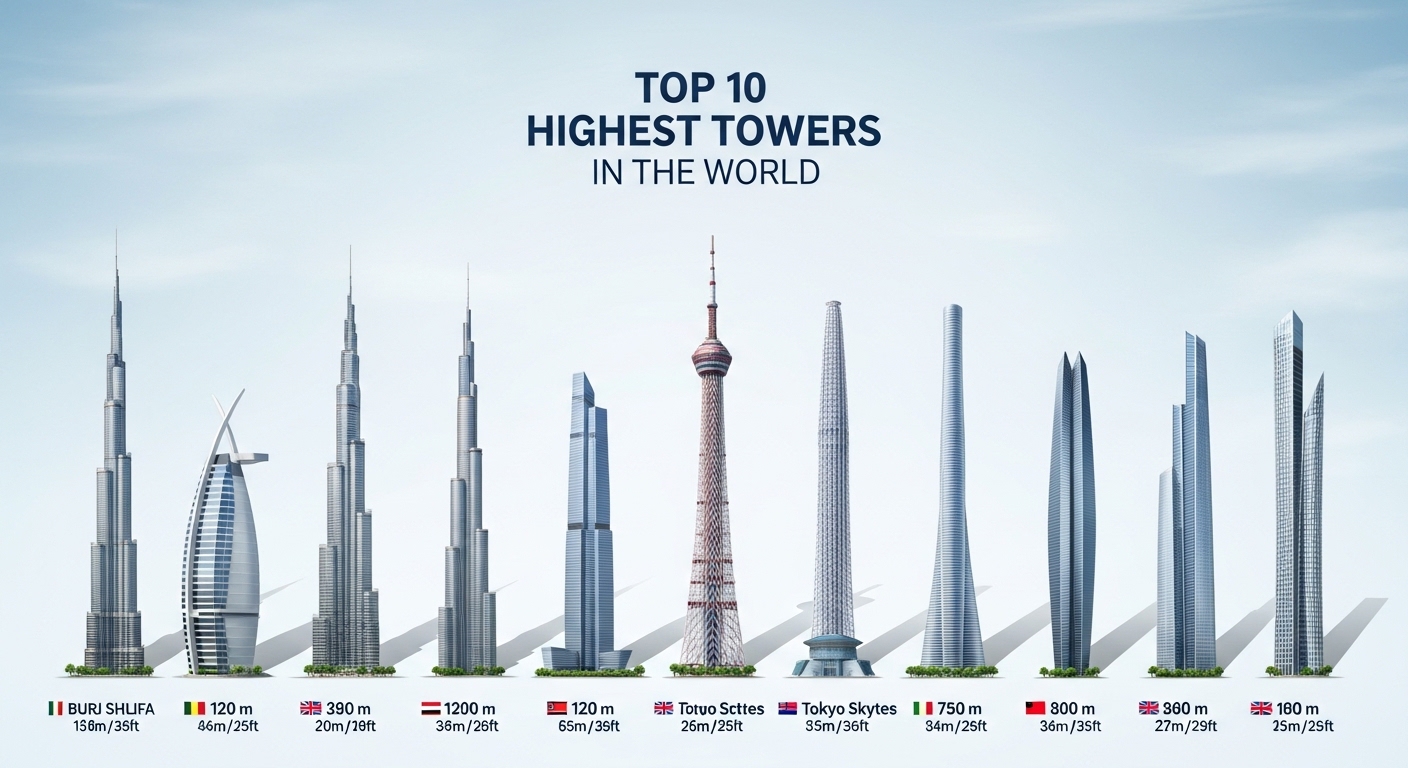
The race to build higher and more impressive structures has defined modern architecture. Across the globe, countries compete to showcase their engineering capabilities by constructing towering skyscrapers and observation towers that redefine city skylines. The Top 10 Highest Towers in the World are not just tall—they are symbols of innovation, economic strength, and cultural identity.
In this comprehensive guide, we explore the Top 10 Highest Towers in the World, including their heights, design features, construction challenges, and global significance.
1. Burj Khalifa — 828 meters | Dubai
The Burj Khalifa is the tallest structure ever built by humans. Standing at an astonishing 828 meters, it dominates the skyline of Dubai and has become one of the most recognized landmarks in the world.
Construction began in 2004 and was completed in 2010. The tower uses a “buttressed core” structural system, which allows it to remain stable despite its extreme height. Engineers designed it to withstand high winds and desert temperatures.
The building includes luxury apartments, corporate offices, the Armani Hotel Dubai, and multiple observation decks. The Burj Khalifa also attracts millions of tourists annually, making it a major contributor to Dubai’s economy.Top 10 Highest Towers in the World.
Key facts
Location: Downtown Dubai, United Arab Emirates
Height: 828 m (2,717 ft)
Floors: 163 habitable, plus spire levels
Architect: Skidmore, Owings & Merrill (Adrian Smith, chief architect)
Opened: January 4, 2010
2. Tokyo Skytree — 634 meters | Tokyo
Tokyo Skytree is the tallest tower in the world used primarily for broadcasting. Completed in 2012, it serves as a digital broadcasting hub for the Tokyo metropolitan area.
Its design is inspired by traditional Japanese pagodas, which are known for their earthquake resistance. The tower incorporates a central column that absorbs seismic shock, making it highly stable during earthquakes.
Visitors can access two observation decks that provide panoramic views of Tokyo. On clear days, you can even see Mount Fuji. The Skytree is also a major tourist attraction, featuring shopping complexes and restaurants at its base.
Key facts
Height: 634 meters (2,080 feet)
Opened: May 22, 2012
Location: 1–1‑2 Oshiage, Sumida City, Tokyo, Japan
Observation decks: Tembo Deck (350 m), Tembo Galleria (450 m)
Hours: 9 a.m.–10 p.m. (last entry 9 p.m.)
3. Shanghai Tower — 632 meters | Shanghai
The Shanghai Tower is the tallest building in China and one of the most advanced skyscrapers in the world. Its unique twisting design reduces wind load by about 24%, making it both efficient and visually striking.
The tower includes offices, hotels, retail spaces, and observation decks. It is also one of the most environmentally friendly skyscrapers, using wind turbines and rainwater collection systems.
High-speed elevators inside the building are among the fastest in the world, reaching speeds of over 70 km/h. This tower represents China’s rapid technological and economic growth.
Key facts
Height: 632 m; 128 above-ground floors
Design firm: Gensler
Opened: 2016
Main observatory: Floors 118–119 (546–552 m)
Elevator speed: 20.5 m/s (world record)
4. Abraj Al Bait Clock Tower — 601 meters | Mecca
The Abraj Al Bait Clock Tower is a central feature of a massive complex near the Grand Mosque in Mecca. It is one of the tallest towers in the world and serves millions of Muslim pilgrims annually.
The tower features one of the largest clock faces ever built, visible from kilometers away. It also includes luxury hotels, shopping centers, and prayer areas.
Its architectural style blends modern engineering with Islamic design elements, making it both functional and culturally significant.
Key Facts
Location: Mecca, Saudi Arabia
Height: 601 meters (1,972 feet)
Completed: 2012
Architect: SL Rasch GmbH and Dar Al-Handasah
Function: Hotel, residential, and observation tower
5. Ping An Finance Center — 599 meters | Shenzhen
The Ping An Finance Center is a symbol of Shenzhen’s transformation into a global financial hub. Standing at 599 meters, it is one of the tallest office buildings in the world.
The tower features a sleek, modern design and includes offices, retail spaces, and observation areas. It was designed to be highly durable and resistant to extreme weather conditions.
Its construction reflects China’s rapid urban development and growing economic influence.
Key facts
Location: Futian District, Shenzhen, Guangdong, China
Height: ~599 m (architectural); ~660 m including crown measurements
Floors: 115 above ground, 5 basement levels
Primary use: Offices, retail mall, dining, observation deck
Completion: 2017; tallest building in Shenzhen since then
6. Lotte World Tower — 555 meters | Seoul
Lotte World Tower is the tallest building in South Korea and a major landmark in Seoul. Completed in 2017, it features a sleek glass design that reflects the surrounding city.
The tower houses offices, luxury residences, a hotel, and observation decks. Its top floors offer stunning views of Seoul and the Han River.
The building is designed to withstand earthquakes and strong winds, ensuring safety despite its height.
Key facts
Height: 555 meters (1,821 feet)
Stories: 123
Opened: April 2017
Location: 300 Olympic-ro, Songpa-gu, Seoul
Architect: Kohn Pedersen Fox Associates
Owner: Lotte Group
7. One World Trade Center — 541 meters | New York City
One World Trade Center is not only one of the tallest towers in the world but also a symbol of resilience. Built on the site of the original World Trade Center, it represents strength and renewal.
The tower includes office spaces and an observation deck known as “One World Observatory.” It offers panoramic views of New York City and beyond.
Its height of 541 meters (1,776 feet) is symbolic, representing the year of American independence.
Key facts
Location: Lower Manhattan, New York City
Height: 1,776 feet (541 meters)
Floors: 104
Opened: November 3, 2014
Architect: David Childs (Skidmore, Owings & Merrill)
8. Guangzhou CTF Finance Centre — 530 meters | Guangzhou
This tower is known for its modern design and high-speed elevators. It includes offices, luxury hotels, and residential apartments.
The building uses advanced materials and construction techniques to ensure durability and efficiency. It is a key part of Guangzhou’s rapidly developing skyline.Top 10 Highest Towers in the World.
Key facts
Height: 530 meters (1,739 feet)
Floors: 111 above ground, 5 below
Completion: 2016
Architect: Kohn Pedersen Fox Associates
Developer: Chow Tai Fook Enterprises
9. Tianjin CTF Finance Centre — 530 meters | Tianjin
The Tianjin CTF Finance Centre features a smooth, curved design that reduces wind resistance. It is a mixed-use building with offices, hotels, and serviced apartments.
Its aerodynamic structure and modern technology make it one of the most advanced towers in the world.
Key facts
Location: Binhai New Area, Tianjin, China Tianjin
Height (architectural): 530 m / 1,739 ft
Floors: 97 above ground (101 including 4 basement levels)
Primary uses: Offices, serviced apartments, luxury hotel
Completion: 2019; tallest building completed that year
10. CITIC Tower — 528 meters | Beijing
Also known as “China Zun,” the CITIC Tower is inspired by ancient Chinese wine vessels. Its unique shape symbolizes tradition combined with modern innovation.
The building includes offices and business facilities, making it a major hub in Beijing’s financial district.Top 10 Highest Towers in the World.
Key facts
Location: Beijing, China
Height: 528 meters (1,732 feet)
Floors: 108 above ground, 8 below
Completion: 2018
Architect: Kohn Pedersen Fox Associates (KPF)
Primary use: Office and mixed-use
🌟 Engineering and Design Innovations
The Top 10 Highest Towers in the World incorporate groundbreaking technologies:
- Wind resistance systems to prevent swaying
- Earthquake-resistant structures for safety
- High-speed elevators for efficient movement
- Sustainable features like solar panels and water recycling
These innovations make it possible to build taller and safer structures than ever before.Top 10 Highest Towers in the World.
📊 Global Trends
Most towers in the Top 10 Highest Towers in the World are located in Asia and the Middle East. This reflects rapid urbanization and economic growth in these regions.
Countries invest in tall buildings to:
- Showcase technological advancement
- Attract tourism
- Support business and commercial activities
Conclusion
The Top 10 Highest Towers in the World represent the pinnacle of human engineering and creativity. From the record-breaking Burj Khalifa in Dubai to the innovative designs of China’s skyscrapers, these structures continue to push the limits of what is possible.
As technology advances, even taller and more impressive towers are expected in the future. These landmarks will continue to inspire architects, engineers, and travelers around the world. Top 10 Highest Towers in the World.