SpaceX Starship Test Ends in Explosive Spectacle
SpaceX Starship Test Ends in Explosive Spectacle
In a dramatic display watched by millions worldwide, SpaceX’s latest Starship test flight ended in a mid-air explosion, reigniting discussions about the challenges and promises of space exploration. The event, streamed live on multiple platforms, showcased both the cutting-edge technology of the private aerospace industry and the inherent risks of pushing the boundaries of human ingenuity.
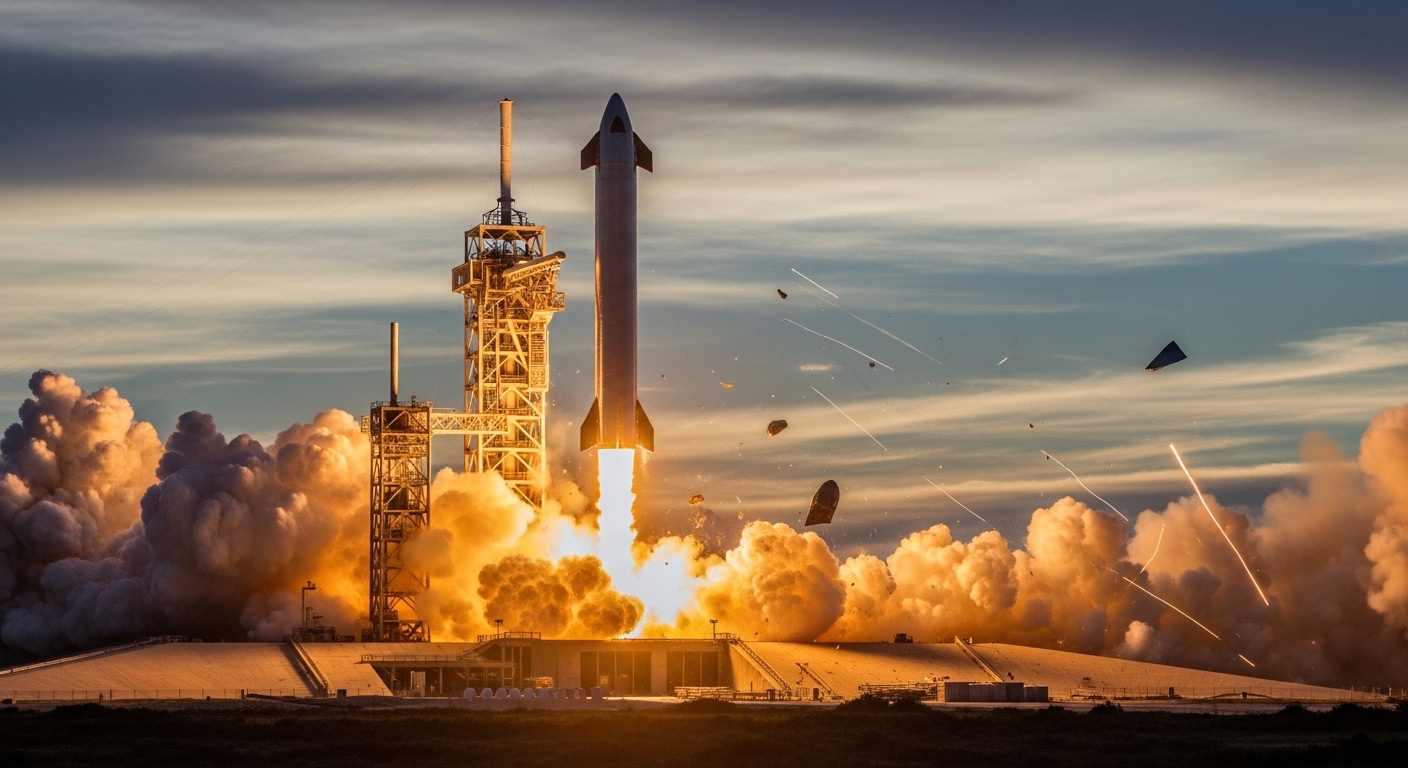
The Starship rocket, designed to eventually carry humans to Mars, lifted off successfully from SpaceX’s launch site in Boca Chica, Texas. The initial ascent was smooth, with engines firing perfectly and telemetry data confirming that the rocket was following its intended trajectory. Viewers around the globe were captivated by the sheer size and power of the spacecraft, which towers over previous rockets at more than 120 meters in height.
However, just minutes into the flight, observers witnessed the rocket lose stability, resulting in a catastrophic explosion. Debris scattered across the launch site, though no injuries were reported. The explosion, while dramatic, was not entirely unexpected for an experimental rocket at this stage of development.
SpaceX founder and CEO Elon Musk addressed the incident on social media shortly after the test, calling the event “a valuable learning opportunity.” Musk emphasized that failures are a critical part of the iterative engineering process that will eventually allow Starship to transport humans safely to Mars and beyond. “Every test gives us new data,” Musk said. “This is how progress is made.”
The explosion has sparked widespread discussion on social media, with thousands of users sharing video clips and speculating about the causes. Many expressed awe at the rocket’s power and design, while others debated the safety and feasibility of manned missions to Mars. Experts note that such failures, while visually spectacular, are an expected step in the development of cutting-edge aerospace technology.
Dr. Linda Chen, an aerospace engineer at the University of California, explained the challenges: “When you’re building the largest rocket ever constructed, there are bound to be failures. Each flight, whether successful or not, provides invaluable data. Engineers can use that data to refine designs and improve safety protocols for future launches.”
The Starship program is part of a broader push by SpaceX to make space travel more accessible and sustainable. Unlike traditional rockets, Starship is designed to be fully reusable, reducing costs and environmental impact. It’s intended not only for missions to Mars but also for lunar landings, satellite deployment, and even point-to-point transportation on Earth.
Despite the explosion, SpaceX has continued its rigorous testing schedule. Previous test flights have ended in similar dramatic fashion, yet each has contributed to incremental improvements in design and functionality. Analysts suggest that this pattern reflects the high-risk, high-reward nature of private space ventures, contrasting with the more conservative approaches historically used by government space agencies.
Public fascination with SpaceX’s endeavors is fueled not only by the technical achievements but also by the broader vision of making humanity a multiplanetary species. The idea of traveling to Mars, once the domain of science fiction, has captured the imagination of millions. Social media platforms are flooded with fan art, memes, and discussions about how soon humans might set foot on the Red Planet.
Economically, the Starship program represents a significant investment. SpaceX has poured billions of dollars into the project, supported by private investors and revenue from satellite launches and government contracts. Industry analysts suggest that success in developing a reliable, reusable rocket could revolutionize space travel, lowering costs dramatically and opening opportunities for commercial ventures previously considered impractical.
Safety remains a top priority, despite the explosive nature of test flights. SpaceX has implemented strict protocols to ensure no personnel are at risk during launches. The company’s approach emphasizes learning from failures quickly, iterating designs rapidly, and maintaining a culture where experimentation is encouraged. This philosophy has allowed SpaceX to achieve milestones that were previously considered improbable, such as reusing Falcon 9 rockets for multiple missions.SpaceX Starship Test Ends in Explosive Spectacle
The global reaction to the Starship explosion underscores the growing public interest in private space exploration. While traditional space agencies like NASA and ESA continue their research, private companies such as SpaceX, Blue Origin, and Rocket Lab are driving innovation at an unprecedented pace. The collaboration and competition between public and private entities are accelerating the timeline for interplanetary travel.SpaceX Starship Test Ends in Explosive Spectacle
Beyond the technical and economic implications, the Starship program raises philosophical questions about humanity’s future. If successful, transporting humans to Mars could reshape society’s understanding of what is possible, inspire a new generation of scientists and engineers, and prompt discussions about ethics, sustainability, and planetary stewardship.SpaceX Starship Test Ends in Explosive Spectacle
For now, SpaceX remains focused on iterative testing. Engineers will analyze flight data to identify the cause of the failure, make necessary adjustments, and prepare for the next launch. Each attempt, even when ending in failure, moves the program closer to achieving its ambitious goals. Musk has stated that he envisions sending an unmanned mission to Mars within the next few years, followed by a manned expedition that could mark the first human settlement on another planet.
In the broader context, the Starship explosion serves as a reminder that space exploration is inherently risky but profoundly rewarding. The excitement, controversy, and discussion generated by the event highlight society’s fascination with pushing boundaries and exploring the unknown. As SpaceX continues its work, the world watches closely, balancing awe with caution, and dreaming of a future where humanity is no longer confined to Earth.
Ultimately, the Starship test flight—though ending in fire and debris—represents more than a single failure. It is a symbol of progress, curiosity, and ambition. Each setback is a stepping stone toward realizing one of the most audacious human endeavors: becoming a multiplanetary species. With each launch, the vision of humans walking on Mars moves one step closer to reality, inspiring millions to look up at the night sky and imagine what might be possible in the next decade and beyond.