Amazing facts about the world
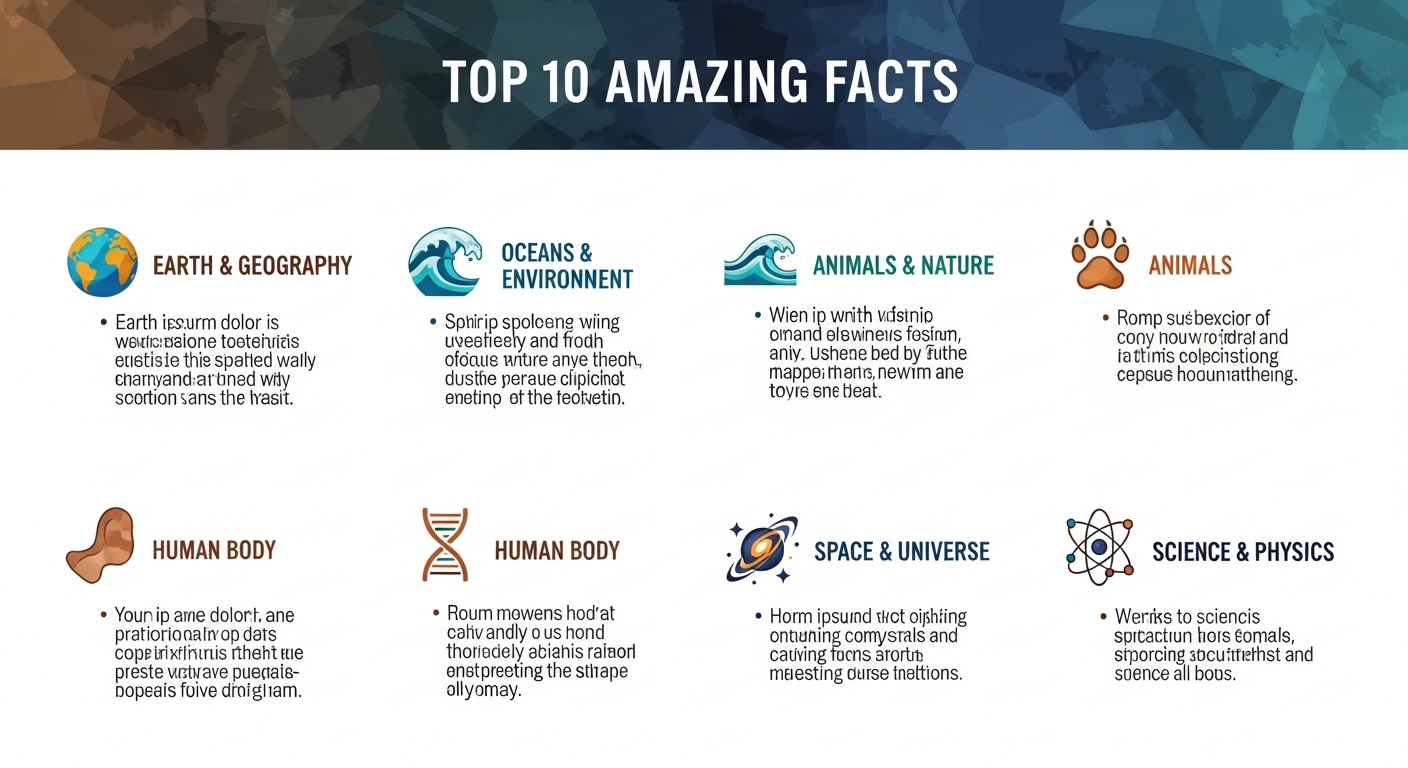
Amazing facts about the world 10 amazing facts about the world that are fascinating, surprising, and sometimes mind-blowing:
🌍 Earth & Geography
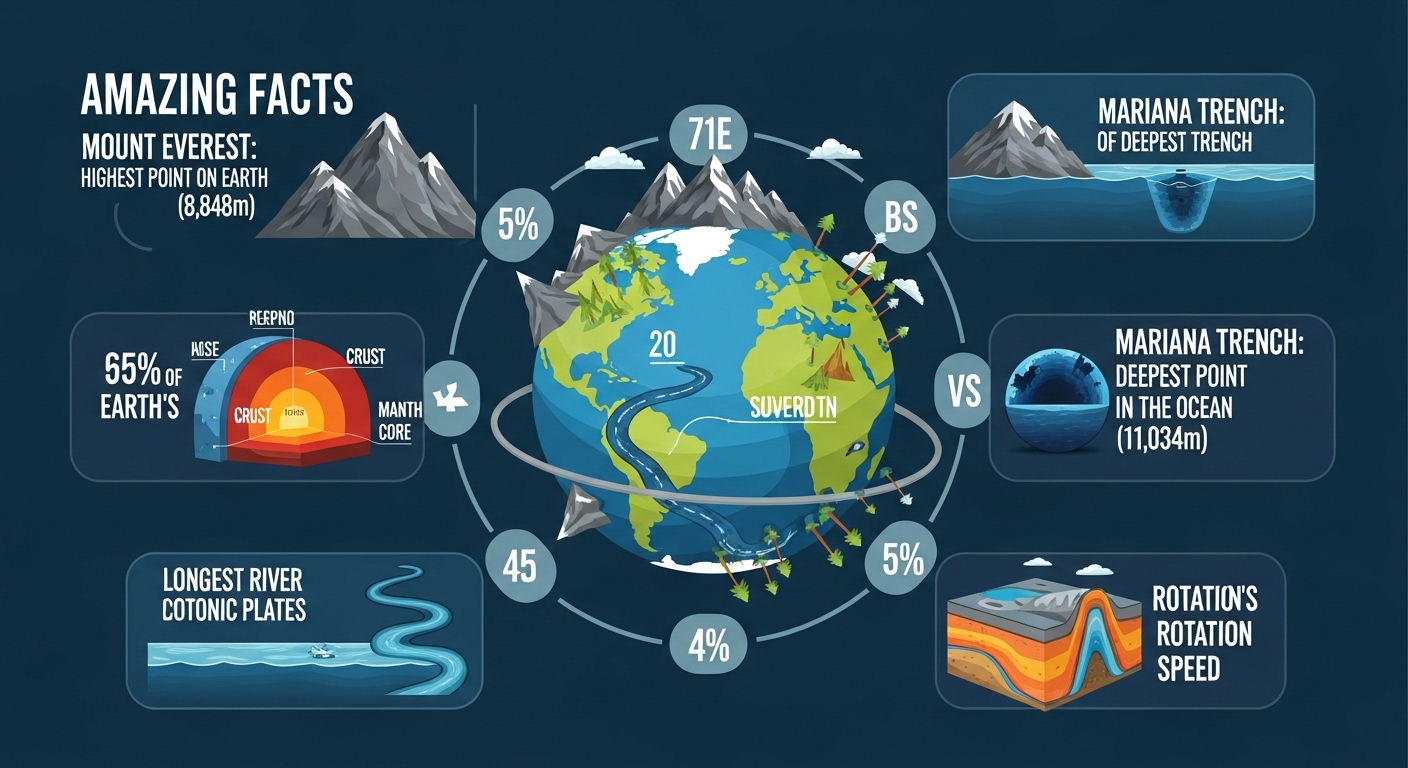
The planet we live on is full of surprising geographical features that challenge what we often assume. First, the Earth is not a perfect sphere. Instead, it has a slightly flattened shape at the poles and a bulging equator due to its rotation. This shape is known as an oblate spheroid, and it affects gravity, sea levels, and even satellite movement.
Another fascinating geographical fact is about deserts. When people imagine deserts, they usually think of hot, sandy places like the Sahara. However, the largest desert in the world is actually Antarctica. It qualifies as a desert because it receives extremely low amounts of precipitation each year. Despite being covered in ice, it is drier than many hot deserts.
In addition, Earth’s most extensive mountain range is not visible on land. The mid-ocean ridge system stretches for more than 65,000 kilometers beneath the ocean’s surface. Formed by tectonic plates pulling apart, it is a powerful reminder that much of Earth’s geography remains hidden beneath the seas.
🌊 Oceans & Environment
The oceans are one of the most important systems on Earth, yet they are often misunderstood. One of the most amazing facts is that oceans produce more than half of the oxygen we breathe. Tiny organisms called phytoplankton use sunlight to perform photosynthesis, releasing oxygen into the atmosphere. Without them, life on Earth would struggle to survive.
Another critical environmental fact concerns freshwater. Although Earth appears rich in water, only about 2.5% of it is freshwater. Even more surprising is that most of this freshwater is trapped in glaciers and ice caps, making it inaccessible for everyday use. This leaves only a small fraction available for drinking, agriculture, and industry.
These facts highlight how delicate and interconnected Earth’s environmental systems are. Small changes in ocean temperature or ice levels can have massive global consequences.
🐾 Animals & Nature
The animal kingdom is filled with creatures that seem almost unbelievable. For instance, the Octopus is one of the most unique animals in the ocean. It has three hearts, and its blood is blue due to the presence of copper-based molecules. Interestingly, two of its hearts stop beating when it swims, which is why it prefers crawling along the ocean floor.
Another remarkable creature is the Ant. Despite its tiny size, an ant can carry objects many times heavier than its own body weight. This incredible strength, combined with teamwork and communication, allows ants to build complex colonies and survive in a wide range of environments.
Nature constantly surprises us with such adaptations, showing how life evolves in creative and efficient ways to overcome challenges.
🧠 Human Body
The human body is just as fascinating as the natural world. One of its most impressive organs is the brain. It generates about 20 watts of electrical power, which is enough to light a small bulb. This energy supports billions of neurons communicating with each other, allowing us to think, learn, and make decisions.
The brain also processes an enormous amount of information every second, often without us even realizing it. From controlling breathing to interpreting sensory input, it works continuously to keep us functioning. This level of complexity makes the human brain one of the most advanced systems known to science.
Understanding the human body not only helps us appreciate its capabilities but also encourages us to take better care of our health.
🌌 Space & Universe
When we look beyond Earth, the scale of the universe becomes almost impossible to comprehend. Scientists estimate that there are more stars in the observable universe than grains of sand on all the beaches on Earth. This comparison helps illustrate the immense size and mystery of space.
Each star may host its own system of planets, raising the possibility that life could exist elsewhere. Despite centuries of study, we have only explored a tiny fraction of the universe. New discoveries are constantly being made, expanding our understanding of how everything began and how it continues to evolve.
The vastness of space reminds us of how small our planet is, yet also how special it is as a home for life.
⏳ Science & Physics
Science reveals that reality is often very different from how it appears. One of the most mind-bending concepts comes from the Theory of Relativity. According to this theory, time is not constant. It can speed up or slow down depending on gravity and motion.
For example, time passes slightly faster at higher altitudes where gravity is weaker. Although these differences are extremely small, they are measurable and must be accounted for in modern technologies like GPS systems.
This idea changes how we think about time—not as a fixed flow, but as something flexible and influenced by the universe itself. It shows that even basic concepts like time and space are more complex than they seem.
🌟 Conclusion
These ten facts, spread across different topics, show just how incredible our world truly is. From the shape of the Earth to the mysteries of time, each fact reveals a deeper layer of understanding about the universe we live in. The oceans sustain us in ways we often overlook, animals demonstrate extraordinary abilities, and the human body continues to amaze scientists with its complexity.
At the same time, the vastness of space and the strange nature of physics remind us that there is still so much to learn. Every discovery opens the door to new questions, encouraging curiosity and exploration.
In the end, what makes these facts so amazing is not just their uniqueness, but how they connect to form a bigger picture. They show that the world is not only a place we live in but also a system full of wonder, complexity, and endless opportunities to discover something new.